|
Commander John Morris-Jones, who has died
aged 82, commanded the Seahawk fighter bombers of 895 Naval
Air Squadron in a series of dashing raids during the Suez
War of November 1956.
Morris-Jones was the leader in 14 of his
30 sorties, which included repeated attacks on the Egyptian
air force at Almaza and Bilbeis, despite intense and
accurate flak; he strafed a column of tanks on the
Ismailia-Tel al Kebir road, destroying one and damaging two
others.
He also bombed six-inch gun emplacements
at Port Faud; sank two Egyptian motor torpedo boats; he
would have sunk a third if the captain of the carrier
Bulwark had not instructed him to allow it to pick up
survivors.
Morris-Jones narrowly avoided contact
with two USN FJ-3 fighters flying from the carrier Coral Sea,
which interfered with British operations by deliberately
steaming through Bulwark's screen protecting British
destroyers.
Next day he led six Seahawks in accurately
strafing Egyptian troops dug in around a cemetery, and then
making a rocket attack on the governate in the centre of
Port Said: one rocket missed the side of the building and
skittered down the road to blow up an anti-aircraft unit
which had been set up at a road junction.
As the only fully qualified
photo-reconnaissance officer in Bulwark, Morris-Jones also
undertook several solo missions to photograph and record the
progress of the battle.
In five days of the most intense fighting,
he and his men destroyed 33 aircraft on the ground and
damaged a further 65. Uniquely, Morris-Jones's squadron
suffered no losses, and he was appointed MBE.
John Morris-Jones was born on January 29
1924, the son of a chief engine room artificer on loan to
the Australian cruiser Encounter when she captured the
German-commandeered steamer Zambesi in August 1914.
Young John went to Tiffin boys' school,
Kingston-upon-Thames, then was apprenticed to Vickers
Armstrong (Aircraft) before joining the Fleet Air Arm at 19.
After training in Florida, his first
operational type was the Corsair, which had become a superb
carrier aircraft after the US Navy had rejected it as the
"ensign-killer".
In August 1945 his squadron disembarked
from the carrier Vengeance to Kai Tak in Hong Kong in August
1945, where he helped restore civilian government and public
services. Later, flying the Seafire, he made some of the
first deck landings on the carrier Eagle.
When the Royal Australian Navy bought the
carrier Terrible and renamed her Sydney in 1948,
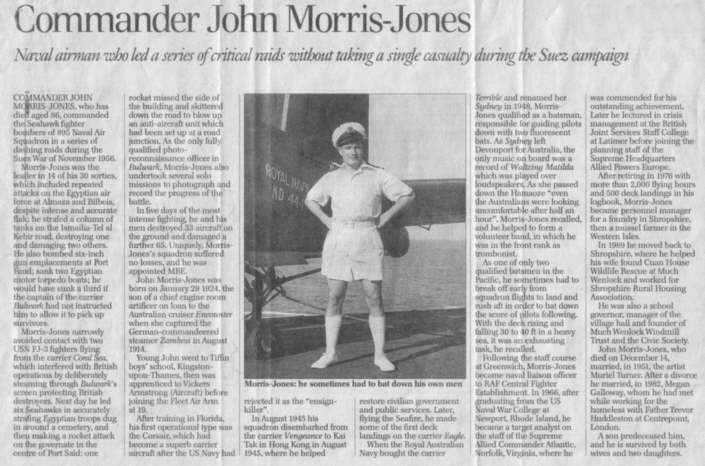
Morris-Jones qualified as a batsman, responsible for guiding
pilots down with two fluorescent bats.
As Sydney left Devonport for Australia,
the only music on board was a record of Waltzing Matilda
which was played over loudspeakers. As she passed down the
Hamaoze "even the Australians were looking uncomfortable
after half an hour", Morris-Jones recalled, and he helped to
form a volunteer band, in which he was in the front rank as
trombonist.
As one of only two qualified batsmen in
the Pacific, he sometimes had to break off early from
squadron flights to land and rush aft in order to bat down
the score of pilots following. With the deck rising and
falling 30 to 40 ft in a heavy sea, it was an exhausting
task, he recalled.
Following the staff course at Greenwich,
Morris-Jones became naval liaison officer to RAF Central
Fighter Establishment. In 1966, after graduating from the US
Naval War College at Newport, Rhode Island, he became a
target analyst on the staff of the Supreme Allied Commander
Atlantic, Norfolk, Virginia, where he was commended for his
outstanding achievement.
Later he lectured in crisis management at
the British Joint Services Staff College at Latimer before
joining the planning staff of the Supreme Headquarters
Allied Powers Europe.
After retiring in 1976 with more than
2,000 flying hours and 500 deck landings in his logbook,
Morris-Jones became personnel manager for a foundry in
Shropshire, then a mussel farmer in the Western Isles.
In 1989 he moved back to Shropshire, where
he helped his wife found Cuan House Wildlife Rescue at Much
Wenlock and worked for Shropshire Rural Housing Association.
He was also a school governor, manager of
the village hall and founder of Much Wenlock Windmill Trust
and the Civic Society.
John Morris-Jones, who died on December
14, married, in 1951, the artist Muriel Turner. After a
divorce he married, in 1982, Megan Galloway, whom he had met
while working for the homeless with Father Trevor Huddleston
at Centrepoint, London.
A son predeceased him, and he is survived
by both wives and two daughters. |